Friday, April 30, 2010

Just a normal day...

I went to visit my host mother, Ruzan, at her store today. She works at a place that is for the most part a butcher shop, but they also sell other food items and until recently were also selling gold jewelry. I once and a while stop by her store as it is on the way to the aftogayan where I catch mashrutkas to Yerevan. I came in and sat down while her and she boss, Armen, were grinding meat. I offered to put on some coffee for the three of us. While I was waiting for the little plita to heat up our teeny tiny cups of coffee, fresh meat was delivered to the store. I've never been too excited about buying meat in this country as you may see from the above photo. It usually sits around all day like this, sometimes on a piece of cardboard. Then, when you order it they chop it up on a large wooden block with an axe. My uncle is a butcher and I know how cutting meat is an art to be perfected. But here, you have to be careful when you eat meat because there are always shards of bone embedded in the flesh. Also, they aren't too concerned with sanitizing like we would with raw meat in America. They just wipe up the surface with a wet towel (no soap or bleach) and resume cutting on the same surface all day long, day after day.

This is an electric plita. Every store you walk into will have one of these hidden somewhere so the shop keepers can refuel with coffee periodically throughout the day.

Our mismatched cups and saucers waiting to be filled with the most tasty slow-cooked Armenian coffee. Armen was telling me that his coffee is so much tastier because it is prepared over low heat very slowly. mmm hmmm.

Later in the evening I returned home and told the events of my day to my landlady, Heriknaz. Their home is just a few meters from my front door. Its nice to be so close to a family, and also very amusing. Heriknaz is from the village Getap and, like many Armenians, has only traveled to a few places within the country. She is a very simple minded woman, but is always curious about what crazy American things I am up to at all times. He has asked me before if, when I had a horse, did I milk it? And, if I knew how to count Armenian money. 700 dram, do you know what 70o dram is?

Thursday, April 29, 2010

Mersum em!

This is taken from the ridge next to my new house. Lately there have been some beautiful low laying clouds covering the mountains and it has been raining like crazy. The semi-desert scrub has suddenly come to life and the mountains around here are just stunning covered in green! Click on the image to see it bigger.

This is a half-abandoned factory near my house.

Mud-puddle dodging. A fine art in these parts.

My teeny tiny neighbor Heriknaz. She sits on the steps and watches her husband, Samvel, remodel the structure by my house. By the end of the summer, there will be three more rooms, just like mine, that will house university students. Always a construction project going on here...

Yeghegnadzor Media Center

Check out the new blog I created for the Yeghegnadzor Media Center that my counterpart and I will be opening soon: http://yeghmediacenter.wordpress.com/ . It is VERY basic right now, but as soon as we start lessons and get money to buy equipment, we'll be on the ground running very soon! It is written in Armenian, but there will be photos and videos to view as well. Enjoy!!

SunChild event at Tsitsernakaberd

SunChild had all the clubs from the regions gather at Tsitsernakaberd in Yerevan (genocide memorial and museum) this weekend to help recycle all the flowers that had been left there after the genocide remeberance day.

We plucked the petals off the flowers and laid them out on long strips of canvas in front of the memorial.

It was quite a beautiful and collective effort.

There were about 3-4 tons of flowers that had been placed there. Usually, every year the flowers are just thrown in the landfill. So SunChild suggested we have the children pluck off the petals and separate the plastic from the greens. We then collected all the stems and leaves and put them in a large compost pile. We were there all day and hardly even got half-way through the pile.


It was a great idea, but a huge effort!

Saturday, April 24, 2010

Genocide Memorial Day

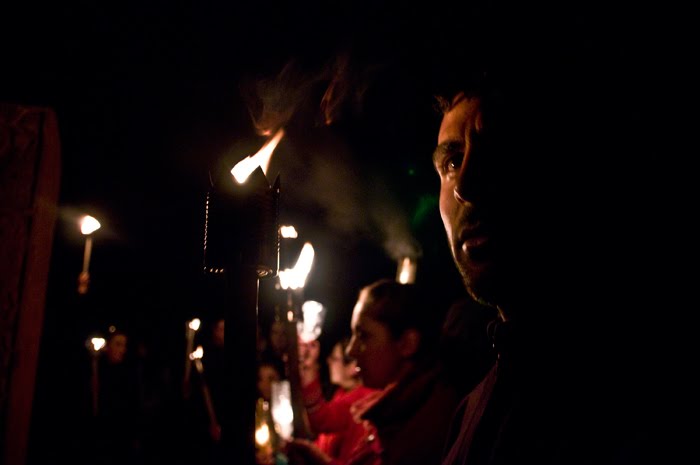
Today, April 24th has been designated as the Armenian Genocide Memorial day. Last night, Jon Henni and I joined some students from the universities in Yeghegnadzor for a candle-lit march to the memorial up on a hill above the city.


The pastor said, Armenia may be small but our problems are large and we must all work together to solve them.

Wednesday, March 31, 2010

Opening day photos

Paige and the photos. We were just a little excited to get the show on the road.

And here is me and the photos. All snazzed up!

The amazing Miss Henni, the organizer of the show.

The "We-are-women-hear-us-roar" crew.

Paige talking about some photos with Lee Lacy, Peace Corps Armenia Country Director, and Armen , PC Environmental Education Program Manager.

Sona and me. Sona showed up early to the exhibit, as she rode the marsrutka to get there. She was in the building before we showed up. We found her in the gallery reading her story and looking at her photos with tears in her eyes. This really cemented our feelings that this exhibition was a big deal and something Armenian women would never think to organize for themselves about themselves.

We had many guests from the Yeghegnadzor community. This man is from the governor's office. He said he was very impressed with all the women in the exhibit and he recognized almost everyone's faces. He even told some stories about some of the women he knew.

Anahit looking at her photos surrounded by some of her classmates.

Paige and Knarik. Knarik took the early mashrutka from Yelpin to Yeghegnadzor, about a 35 minute drive.

Knarik and her sister-in-law, Aygestan. Aygestan and her family were Paige's second host family in Vayk. Both women are featured in the exhibition.

Henni thanking our guests and explaining the premise of the project. About 50 people were crammed into the little gallery, but everyone was enjoying themselves. We baked American cookies and crackers with a goat cheese dip and served champagne to toast the women. Henni collected information from UN and Amnesty International's websites and had students from the university write up data and essays about the state of the women in Armenia. Many guests told us that they were happy to see the data, as it reminded them of why women are important and how they have been ignored.

Henni and Sona. Many of the women in the exhibition are from the village Getap, where Henni has a family that she visits several times a week. In Getap Henni has become a celebrity. Sona and her family are one of the many families Henni has become close with.

Meester Jon, Peace Corps volunteer, my site mate. The one and only.

My marz-mates. These are my Americans, and they will all be leaving me in August. Bah ho.

Some girls from my Eco Club.

The after party at my apartment.

Tuesday, March 30, 2010

Ruzan Khatchatryan

Ruzan Khatchatryan, 55 years old


Mother of many and master of most, Ruzan Khatchatryan doesn’t spend much time sitting idle. The mother of two girls and one boy is also surrogate mother to seven Peace Corps Volunteers, one of whom is currently serving in Yeghegndadzor (Emily Haas), while the others have safely returned to America and call their Armenian mother occasionally. While she may recall with fondness the times she had spent with the Americans living with her in the past, it also brings back memories of what her house was like when it was full. Ruzan’s husband died just one year ago, her son is serving in the army in Sisian, her oldest daughter is married and lives in Russia and the other is married with two young children and rarely gets an opportunity to visit.

Ruzan works 12 hours a day, seven days a week in a khanut preparing kebabs, selling various sundries and most recently gold jewelry. Work, she said, is something that still keeps her going. While her children were studying in university, all of her children graduated with college degrees from universities in Yerevan, Ruzan kept a cow, her garden and the household. She worked from sunrise until sunset everyday and gave every thing she earned to her children so they could pay their tuition and afford to live in Yerevan. She is tremendously proud of what her children have accomplished and says that she has always held the future of her children as her highest priority.

Ruzan was born in the village of Agarakadzor and most of her family still lives there. While she is waiting for her son to return and for the pain of her recent loss to recede, she occupies her time by staying close to her loved ones and keeping close her sweet memories from the past.

Thursday, March 25, 2010

Nunufar Karapetyan


Nunufar Karapetyan, 31 years old

“Yes masnaget em! – I am a specialist!”


Nunufar is specialist in selling wine. Coming from Yerevan you can see the yellow parasol, the sign that says ice cream and her conspicuous red hair as one of the first points of sale on the right. Cars honk, people wave out of their window; Nunufar is known all over the road Yerevan- Yeghegnadzor. If you were wondering if ever cars stop on the road to buy something at Nunufar’s place, they definitely do. Maybe it is an ensemble of her tasty wine and her prepossessing character. Her cheerful laugh and her hospitality are remarkable. She serves her customers big glasses of wine, coffee, cookies and apples. Nunufar was selling wine in several markets in the area for 13 years before her family opened the place on the road. Now she has been selling there for five years and she seems to love her job. She works from 9 p.m. to 9 a.m. every day and never takes a vacation. In her small selling house she has a stove to cook and a radio. She says that she could never leave her village, even though she is very interested in other cultures and languages. Maybe if she wouldn’t have this point of sale, maybe.


Nunufar speaks not only Armenian, she also remembers German and Russian that she learned in school. She learned Persian on her own and knows Turkish from the trips she went on with her father to Nachitshevan. When she was a little girl her father went hunting in the territory of Nachitshevan, which was easily accessible from the village Areni.
Nunufar is the oldest child in her family. Her brother died and her sister is married in Karabach. She is not married and stays with her parents. She never had the chance to study after school, but she studies herself languages and reads a lot about environmental issues.

Wednesday, March 24, 2010

Tamara Avetisyan

Tamara Avetisyan, 55 years old

“We have children”

Tamara Avetisyan is the mother of four children, two girls, two boys and grandmother of four. She lives together with one of her daughters, her daughter-in-law and two of her grandchildren in the village Getap. If you ask her she would tell you that they have children, she takes care of her grandchildren like a mother day and night. Her daughter-in-law works as a doctor in the hospital, both of her sons live in Russia, as well as her husband. Tamara used to live in Karelia, Russia as well, but she came back to live with her grandchildren and her younger daughter. She is a mother and grandmother with passion. She would do everything for them. She tried to earn as much money as possible to help her children study; she worked as dancing teacher in Getap from 1972 to 1975, worked in the kindergarten from 1981 to 1994 and lived in Russia from 2001 to 2006.


What is it like to live in a house with only women?
It is not easy for them to go shopping or to visit friends without a car. The two boys ask for their father every day, every day they call their men in Russia or the men call them. Everybody hopes that they could come soon to visit them, but the flights are expensive and they work hard and don’t have vacation time.
New Year’s 2009: I visited them on New Year’s Eve. They were preparing cakes, salads and other very delicious dishes. Every ten minutes the phone was ringing, the father of the kids and the grandfather were calling to ask what they were doing now. On one hand, it was a sad New Year’s, and a very relaxed one on the other. Without men in the home you can do what you want, eat when you want and dance us much as you want.


Some voices in the village put pressure on Tamara, “Your husband has worked enough, why is he still in Russia? It’s time that he comes back and enjoys his pension.” But the father is like his wife; why sit when I can work and help my family?” The daughter explains to me,
Without work my father gets sick. He couldn’t find work here and was getting nervous. That’s why he went to Russia…. If I wanted I could study again and my father would pay for it. But I don’t want to take money from him. I would rather like that he takes the money for a ticket to come visit us.
Family comes before your own interests. For me that is a very impressive fact about Armenia.
When the grandchildren grow up and the youngest daughter marries, Tamara will join her husband in Russia.

Tuesday, March 23, 2010

Gohar Alexsanyan

Gohar Alexsanyan, 44 years old


Gohar Alexsanyan is the epitome of a strong, determined and proud village woman. She is the mother of two girls and one boy. Along with all the responsibilities a woman takes on keeping a household, Gohar also keeps a barn full of pigs and cows, a coop full of hens and roosters and an enormous garden with fruit trees, vegetables and berry bushes. She wakes early in the morning to milk the cow, feed the pigs and let out the chickens. She then prepares breakfast for her children and husband before they head off to school and work.
In the summer time, Gohar spends the day harvesting fruits and vegetables and about once a week takes the yield to Yerevan to sell in the markets. She comes home late and prepares dinner for the family and once again milks the cow, feeds the pigs and puts up the chickens for the night.
Gohar is a lover of knowledge. She was studying at the university in Yerevan when she met her husband, quit her studies and got married. Soon thereafter, her first daughter, Anna, was born. Anna was just recently married this February 13th. Gohar is tremendously proud of her children and the happy prosperous life she and her family have led.


Gohar and her family have also hosted two Peace Corps trainees during the Pre-Service Training. The Americans lived with her family for two and a half months after first arriving in Armenia. When the trainees reach Armenia they only know a few words of the language, so the host family became an interactive classroom and provided a network to other villagers and other family members within the country. The family served as the first contact with Armenian culture and language.

Monday, March 22, 2010

Knarick Avakyan


Knarick Avakyan is an English teacher in the village of Yelpin and is one of the kindest people you will ever meet. She is 47 years old, and she works hard every day teaching English at school and also after school private lessons. Knarick is always interested in connecting herself with the outside world and other people and she likes to read about world news. She always has a beautiful smile on her face despite how difficult it is sometimes to live in a village, work full-time and raise a family. She is married and has two children, Sophie and Tigran, whom she loves very much. She says that it is important to keep a sense of optimism and to believe in the future as a bright light to follow with a sense of happiness and purpose. When Knarick has free time, she likes baking sweets and taking care of her cats. She is proud to be Armenian, and holds up Armenian traditions by being hospitable and kind to her guests. You will never hear Knarick Avakyan saying bad things about people because she believes in finding the best in others. The secret of her happiness is her optimism.

Aygestan Hovhannisyan

Aygestan Hovhannisyan


Aygestan Hovhannisyan has a very traditional Armenian woman’s life. She is married and has three grown children: two sons and one daughter. She takes care of the house by doing all the work that is usually done by women. When the majority of her house work is completed in the afternoons, she enjoys having her girlfriends over for coffee or visiting her neighbors to talk and laugh. She is a very strong woman with good values and is well respected in her community as a person who is honest and kind. Her husband works as an electrician at Vayk’s electrical facility and aside from his monthly wages they also have a greenhouse where they grow seasonal vegetables to sell. In the winter everyone in their family is working hard to clean and harvest “ganachi” and in the summer they sell tomatoes, cucumbers and peppers. She is a very busy woman but always has time to sit with a friend and offer them coffee and fruit. She is the youngest child of five and is from the village of Khnzorut. She loves to plant many different varieties of flowers and it is easy to see that her name “Aygestan” suits her. Her father, almost 90-years-old, comes over to her house from time to time to get his hair cut by her and she is known as the family hairstylist. She is an excellent seamstress and is very creative in making small, useful things for her family. She is a wonderful woman and has a kind and happy husband as well as three very smart and respected grown children.


Friday, March 19, 2010

Sona Vanyan

Sona Vanyan, 40 years old

When you enter the yard of Sona Vanyan, you can smell her profession: lavash, cheese, baklava and many other things appreciated by the whole village.


Sona works from sunrise till sunset. She bakes, cooks, milks the cows, cleans house and yard, she does everything. She has had a hard life, but she is strong, smiles and says, “We don’t live very well, we are not rich, but we thank God for everything we have every day.”


She was 21 when she married, together the couple had a one-year-old son and she was two months pregnant with her daughter. After only one year of marriage her husband died. All alone at 22, she had just moved from Yeghegnadzor into her husband’s house in the village Getap. Since then she lives with her parents-in-law and raises her children alone.
Now she is 40. Her son who is now 19, is serving in the army in Sisian. She shows his picture with pride. Her daughter studies in Getap school and helps her bake lavash when she comes home from school. People from the village bring her flour and she bakes for them the delicious bread. That’s how she earns money.


She sleeps with her daughter on one end of the room, her parents-in-law on the other, separated with just a curtain. The room is dining room, living room and bedroom in one. The woodstove gives it a nice atmosphere, from the TV sounds traditional Armenian music. She serves us all Armenian riches, wine, pasturma, salad, fresh lavash, cheese, meat and eggs, nuts, sujukh and coffee - everything homemade and all natural!
She tells us that she and her daughter were going to a wedding the next day far north of Yerevan. She is preparing all her specialties to make those people as happy as she made us.
We ask her when they will be coming back she answers, “It depends if we like it there or not.” Sona lives in the day…